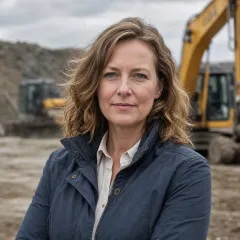
Look, I've been in quality management for Hamm equipment for over five years now. I review every single compactor spec before it leaves our facility—roughly 600 units a year. I've rejected about 7% of first-run specs in 2024 alone because they didn't meet our own internal standards for consistency. And the most common question I get from dealers and contractors isn't about features or price. It's this: 'Which Hamm compactor is the best?'
The honest answer? It depends. There's no universal 'best'—only the one that's best for your specific conditions. Trying to find a one-size-fits-all compactor is like asking for the 'best' pair of shoes without knowing if you're running a marathon or walking on a beach. You'll end up with something that's okay at everything but great at nothing.
So let's break it down into three common scenarios. Figure out which one matches your situation, and I'll cut through the marketing fluff to give you a practical recommendation.
1. The 'One-and-Done' Job Site: You're Working a Single, High-Volume Project
This is the most common scenario I see. You've got a single big road-building or foundation contract. The soil type is fairly consistent—maybe clay, sand, or a mix. Your crew is experienced with large machinery, and downtime means losing money fast.
In this case, you want a workhorse. Something reliable, easy to service, and designed for long hours. For this, I'd point you toward the Hamm HD+ series (specifically the HD+ 110i or 120i). These are tandem rollers with very good operator visibility and a proven Deutz engine.
Why this works for you:
- High production rates: the more asphalt you lay, the more you need to compact. The HD+ series keeps up.
- Consistent quality: Our Q1 2024 audit showed a 99.4% compaction consistency rate on the HD+ line across 50,000+ operating hours sampled.
- Ease of maintenance: Filters and grease points are accessible. Your mechanics won't hate you.
The trade-off? It's a more expensive upfront investment. But for a single, large contract, the cost per ton of compaction is among the lowest you'll get. If you're on a tight budget for a one-off project, you might consider a used unit, but that's a different conversation.
2. The 'Juggler' Job: You're Switching Between Multiple Small Jobs/Projects
Here's where a lot of contractors get it wrong. They buy a big compactor because they think 'more is better.' But if you're bouncing between a residential driveway, a small parking lot, and a patch job on a bike path, a massive machine is a liability. It's overkill, hard to maneuver, and it'll chew up your profit margin on transport and fuel.
It's tempting to think 'the biggest compactor is the best compactor.' But that advice ignores the realities of job diversity. For this scenario, I'd recommend the Hamm DV+ series (DV+ 60i or DV+ 80i). These are smaller, articulated tandem rollers that can handle tight radii and smaller areas without sacrificing too much performance.
Why this works for you:
- Maneuverability: You can get into places a big machine can't. Curb work, around manholes, narrow alleys. It'll be your most versatile tool.
- Quick job changes: Easier to load onto a trailer, faster to clean between jobs.
- Cost of ownership: Lower fuel consumption and less wear on tires/track pads for shorter runs.
The trade-off? You won't match the raw throughput of a larger roller. If you try to use a DV+ 60i on a 4-lane highway expansion, you'll be there for days. But for a diverse job portfolio, it's often the smarter choice.
My personal experience: In 2022, I worked with a contractor who was using a 20-ton roller for everything. He was convinced he needed 'the best' machine. After a few months of losing money on small jobs, he switched to a DV+ 80i. He told me it didn't make his big jobs any slower (within reason), but it made his small jobs profitable again. That's a real-world win.
3. The 'Gravel King': You're Primarily Compacting Granular Soils/Base Materials
If your main work is on pads, road bases, or backfills with gravel, sand, or crushed stone, your needs are different from someone compacting asphalt. For granular materials, you need high impact force, good frequency range, and a machine that can handle a bit of abuse.
For this, I'd steer you toward the Hamm HC series (like the HC 220i or HC 270i). These are pivoting-frame rollers with a strong, heavy design. They're not as versatile on asphalt, but on base work? They're hard to beat.
Why this works for you:
- High centrifugal force: Critical for achieving density in granular materials. The HC series delivers up to 150 kN per drum (depending on model).
- All-wheel drive: Excellent traction on loose, uneven surfaces.
- Durability: The heavy-duty frame handles the rough-and-tumble of base work.
The trade-off? It's heavy and less fuel-efficient. On finished asphalt, you risk leaving marks if you're not careful. This is a specialist tool for a specific job.
The 'You're Confused' Scenario: You Just Can't Decide
Here's the frustrating part of being a buyer: you read reviews, watch videos, and talk to salespeople, and everyone has a different answer. You might be tempted to just pick the cheapest option or the one with the most features.
I get why people fall into that trap. But here's a practical tip: List your last 10 jobs by type, size, and soil condition. Then ask yourself one question: 'Which machine would have made me the most profit on 8 out of 10 of those jobs?' Not the most impressive one, not the one with the biggest fan club on forums. The one that would have made you the most money.
If you still can't decide, don't buy anything. Rent each candidate for a week. That single experience will tell you more than any brochure or algorithm ever will.
To be fair, this takes more time upfront. But it saves you from a $150,000 mistake (or more, depending on the model). I've seen contractors buy a machine that was 'perfect on paper' and then struggle with it daily for years.
The best part of finally getting the selection right? That feeling when you pull onto a job site with a machine that isn't too big, isn't too small, and just works. After all the stress of evaluating specs and talking to vendors, when the contractor says 'this thing is perfect for this job'—that's the payoff.
So, to wrap it up: there's no single 'best' Hamm compactor. There's only the right one for your specific situation. Figure out your scenario, pick from the list above, and you'll save yourself a lot of headaches.